

Vintage Singer sewing machine manuals represent a crucial link to the past, offering invaluable insights into the operation and upkeep of these mechanical marvels.
The Value of Original Documentation
Original Singer sewing machine manuals are far more than just historical artifacts; they are essential resources for restoration, repair, and truly understanding the intricacies of these machines. They provide detailed instructions, often including exploded diagrams of parts, which are invaluable when tackling maintenance or attempting to restore a machine to its original working order.
These manuals offer a direct connection to the original manufacturing intent, detailing the proper techniques for threading, stitch selection, and troubleshooting. Modern resources, while helpful, often lack the nuance and specific details found in the original documentation. Furthermore, understanding the terminology used in these manuals provides insight into the evolution of sewing technology and the craftsmanship of a bygone era. Preserving and utilizing these manuals ensures the longevity and continued functionality of these remarkable machines.
Why Singer Manuals are Sought After
Singer sewing machine manuals are highly sought after by collectors, restorers, and sewing enthusiasts alike due to the enduring quality and historical significance of Singer machines. The demand stems from a desire to maintain these machines, often family heirlooms, and to accurately restore them to their original working condition.
The detailed illustrations and clear instructions within these manuals are crucial for understanding the mechanics of these often complex devices. Online communities dedicated to vintage sewing frequently share and request manuals, highlighting their importance. Moreover, the aesthetic appeal of these manuals – their typography, illustrations, and overall design – adds to their collectibility. They represent a tangible link to a period of craftsmanship and ingenuity, making them valuable pieces of sewing history.

Locating Singer Sewing Machine Manuals
Finding original Singer manuals requires diligent searching through online archives, dedicated websites, and active participation in vintage sewing machine communities and forums.

Archive.org as a Primary Resource
Archive.org stands as an exceptionally valuable, and often the first, port of call for anyone seeking old Singer sewing machine manuals. Its vast digital library hosts a surprisingly large collection of scanned instruction books, parts lists, and supplementary materials for numerous Singer models, spanning decades of production.
The platform’s search functionality, while sometimes requiring experimentation with keywords (including model numbers and variations), generally yields relevant results. Users can often find complete manuals, or even related promotional materials like advertisements and catalogs, offering contextual information. A key benefit is the ability to view manuals online directly within a web browser, or download them as PDF files for offline access.
Recent discussions highlight the joy of discovering rare manuals on Archive.org, such as those for the Stradivaro Radi-O-matic Streamliner. While organization isn’t always perfect, the sheer volume of content makes it an indispensable resource for enthusiasts and restorers alike. It’s a fantastic place to begin your search!
Online Forums and Communities
Beyond Archive.org, a thriving network of online forums and communities dedicated to vintage sewing machines provides a collaborative space for locating old Singer manuals. These platforms often feature dedicated threads where members share links to downloadable manuals, request assistance in identifying models, and discuss troubleshooting techniques.
The value extends beyond simply finding a PDF; experienced members frequently offer guidance on interpreting the often-technical language and diagrams found within these manuals. The humor and camaraderie within these groups are also noteworthy, creating a supportive environment for both beginners and seasoned collectors.
Requests for specific manuals, like one for a Federal sewing machine model H 1051, are common, demonstrating the community’s willingness to assist. Appreciation is often expressed for members’ efforts in preserving and sharing this valuable information, highlighting the collective passion for these machines.
Dedicated Vintage Sewing Machine Websites
Numerous websites specialize in vintage sewing machines, often curating collections of old Singer manuals alongside machine information and restoration guides. These resources frequently offer a more focused search experience than general archives, allowing users to quickly pinpoint manuals specific to their machine model.
These dedicated sites often showcase the normal performance of various vintage models, detailing stitch types and material capabilities – denim, sailcloth, and leather – with accompanying video demonstrations. Comment sections become valuable hubs for repair tips and further links to free instruction manuals.
While website mergers (like Singer, Pfaff, and Husqvarna) can sometimes disrupt manual availability, the community’s resilience ensures resources continue to surface. These websites represent a concentrated effort to preserve the history and functionality of these remarkable machines.

Understanding Singer Manual Contents
Old Singer manuals detail machine identification, comprehensive parts lists with diagrams, and crucial troubleshooting steps for common issues encountered during operation and repair.
Machine Model Identification
Accurate model identification is the cornerstone of utilizing any Singer sewing machine manual effectively. Vintage Singers, spanning decades of production, exhibit a remarkable diversity in design and features. Manuals are specifically tailored to each model, detailing unique components and operational procedures.
Typically, the model number is prominently displayed on a nameplate affixed to the machine. Common locations include the front, right side, or beneath the handwheel. For treadle machines, the number might be found on the cabinet or the machine’s base. Serial numbers, also present on the nameplate, can help pinpoint the year of manufacture.
However, identifying a Singer isn’t always straightforward. Variations exist, and some machines underwent modifications over time. Online forums and dedicated websites (mentioned elsewhere) offer resources for deciphering ambiguous markings and cross-referencing features to determine the correct model. Correct identification unlocks access to the precise manual needed for successful maintenance and repair.
Parts Lists and Diagrams
Singer manuals excel in providing detailed parts lists and exploded diagrams, essential for repair and restoration. These aren’t merely inventories; they’re visual guides to the machine’s internal workings. Parts are typically numbered sequentially, corresponding to descriptions in the accompanying text. Diagrams illustrate how components assemble, aiding in reassembly after disassembly.
These lists often include Singer part numbers, crucial when sourcing replacements. While some original parts remain available through specialized suppliers, modern equivalents may be necessary. Knowing the original part number facilitates finding compatible alternatives. Diagrams showcase the relationship between parts, clarifying complex mechanisms.
Understanding these diagrams requires patience and attention to detail. They depict various views, showcasing components from different angles. Careful study allows even novice mechanics to confidently tackle repairs, ensuring the Singer continues to function smoothly for years to come. They are truly invaluable resources.
Troubleshooting Common Issues
Singer manuals dedicate significant space to troubleshooting, addressing frequent problems encountered by users. These sections are invaluable for diagnosing and resolving issues without specialized expertise. Common complaints, like thread breakage, skipped stitches, or erratic motor function, are systematically addressed.
Manuals often present a logical, step-by-step approach to problem-solving. They guide users through a series of checks – examining the threading, bobbin winding, needle condition, and timing adjustments. Clear instructions and accompanying illustrations simplify the process.
Beyond basic fixes, manuals may cover more complex issues, such as oiling points and cleaning procedures. Regular maintenance, as outlined in these guides, prevents many problems from arising. By following these instructions, owners can restore their Singer’s performance and extend its lifespan, ensuring continued reliable operation.
Specific Singer Manual Eras & Features
Singer manuals evolved alongside their machines, reflecting changing technologies and design philosophies across different eras – from treadle to electric models and beyond.
Featherweight Manuals (221, 222K)
Singer Featherweight manuals, specifically for models 221 and 222K, are highly prized by collectors and users alike due to the machine’s enduring popularity and relative simplicity. These manuals typically feature detailed exploded diagrams illustrating the internal mechanisms, crucial for repair and maintenance. They cover essential operations like threading, bobbin winding, stitch regulation, and troubleshooting common issues such as skipped stitches or tension problems.
Original Featherweight manuals often include specific instructions for attachments, like the hemmer or gathering foot, showcasing the versatility of these compact machines. The clarity of the illustrations and the concise, step-by-step instructions make them accessible even to those with limited sewing machine experience. Digitized versions are readily available online, but original, well-preserved manuals in good condition can significantly increase a machine’s value. Finding a manual with the original supplement for the motor is a bonus!

Treadle Machine Manuals
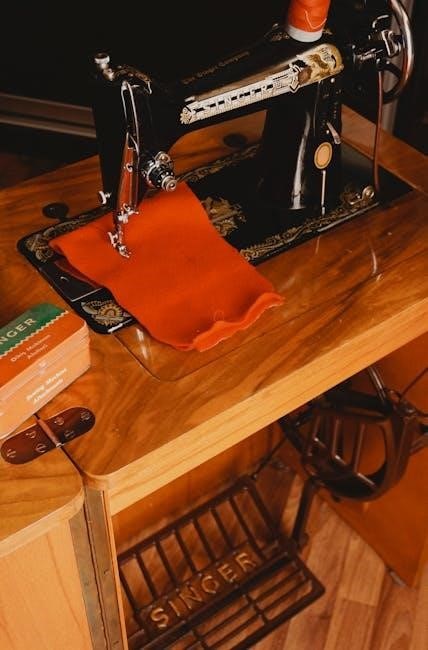
Singer treadle machine manuals represent a fascinating glimpse into a bygone era of sewing technology. These manuals often differ significantly from those of electric machines, focusing heavily on the mechanics of the treadle belt and its impact on stitch quality and speed. Diagrams illustrate the correct belt tension and alignment, vital for smooth operation. Instructions detail how to adjust the treadle wheel for comfortable use and explain the importance of a level sewing surface.
Beyond the treadle specifics, these manuals cover standard sewing operations, but with an emphasis on the operator’s physical rhythm and control. Troubleshooting sections address issues related to the treadle mechanism itself, such as slipping belts or noisy operation. Original manuals frequently include lubrication guides, specifying the correct oils and greases for optimal performance. Preserving these manuals helps maintain a connection to the craftsmanship of early sewing machines.
Electric Singer Manuals (Pre-1950s)
Singer electric sewing machine manuals from before 1950 showcase the transition from manual power to motorized convenience. These manuals detail the operation of early electric motors, emphasizing safety precautions due to the relatively new technology. Diagrams illustrate the wiring and components of these motors, alongside instructions for basic maintenance like oiling and brush replacement. Troubleshooting sections address common electrical issues, such as blown fuses or motor stalling.
Compared to treadle manuals, these guides often include more detailed explanations of stitch regulation and tension adjustments, leveraging the consistent power of the electric motor. They also cover the use of early attachments and accessories, demonstrating the expanding capabilities of these machines. Finding these manuals is crucial for understanding the nuances of these vintage electric models and ensuring their continued functionality.

Restoring and Using Manuals
Digital restoration and careful physical preservation are key to breathing new life into aged Singer manuals, unlocking a wealth of sewing knowledge.
Digital Restoration Techniques
Digitizing old Singer manuals begins with high-resolution scanning, capturing every detail of the original document. Software like Adobe Photoshop or GIMP allows for adjustments to contrast, brightness, and color balance, enhancing readability. Removing blemishes, stains, and foxing—those brownish spots caused by oxidation—requires careful cloning and healing brushwork.
Optical Character Recognition (OCR) transforms scanned images into searchable and editable text, though accuracy can vary with older fonts. Proofreading is essential to correct OCR errors. PDF editing software enables reassembling fragmented pages, creating bookmarks for easy navigation, and reducing file size for convenient sharing.
Consider color correction to restore faded inks, but avoid over-saturation. Maintaining the manual’s original aesthetic is crucial. Finally, backing up digital copies to multiple locations ensures long-term preservation, safeguarding these valuable resources for future generations of sewing enthusiasts.
Preserving Physical Manuals
Protecting original Singer manuals requires careful handling and storage. Avoid direct sunlight, which can fade covers and brittle paper. Store manuals flat in acid-free archival boxes or sleeves, preventing creases and tears. Gentle cleaning with a soft brush can remove loose dust, but avoid liquids.

For damaged manuals, consider professional conservation. Paper repair specialists can mend tears and reinforce weak pages using archival-quality materials. Avoid using tape or adhesives, as they can cause further damage. Digitizing the manual before any repair work provides a backup in case of unforeseen issues.
Humidity and temperature control are vital; a cool, dry environment minimizes deterioration. Regularly inspect manuals for signs of mold or insect damage, addressing any issues promptly. Proper preservation ensures these historical documents remain accessible for research and enjoyment for years to come.
Decoding Vintage Sewing Terminology
Old Singer manuals often employ terminology unfamiliar to modern sewers. Terms like “streamlining,” “radi-o-matic,” and specific stitch names require research to fully understand their function and application. Understanding these terms unlocks the nuances of vintage sewing techniques.
Pay attention to descriptions of attachments; names may differ from contemporary equivalents. “Work holders,” “rufflers,” and various presser feet had specific purposes detailed in the manual. Context clues within the instructions and diagrams are invaluable for deciphering unfamiliar terms.
Online forums and communities dedicated to vintage sewing machines are excellent resources for clarifying terminology. Experienced collectors and restorers can provide insights into the meaning and usage of obscure terms. Building a glossary of vintage sewing language enhances comprehension and appreciation of these historical manuals.